Is Selling Your Amazon Seller Account Legal? What You Need to Know

Rated 4.9 on Trustpilot. Free offer within 24 hours, paid through Escrow.com.
The Short Answer
Selling your Amazon seller account is done as the sale of the business it belongs to, on a written Asset Purchase Agreement, with the new owner then verified by Amazon in their own name. Amazon's two help pages say an account cannot be transferred by itself; neither says a business cannot be sold.
We describe what Amazon's pages say and how a sale closes. We do not give legal advice, and we do not tell you what the law allows. What we can tell you is how we buy your account from you when you sell your Amazon seller account: 1,600+ accounts bought from their original owners since 2020, every one on a signed agreement, with the money held by Escrow.com before anything moves.
If your real question is whether a buyer would take your account at all, that is a separate page: whether you can sell your Amazon seller account covers it in full.
What does Amazon's policy actually say?
Amazon's help page on transfers says "Seller accounts generally are not transferable." Its second paragraph, word for word, is this: "If the ownership of a business changes for any reason, the new owner must establish a new seller account." That is a rule for the new owner, written for Amazon's own system.
It is why every sale we close is recorded as a business sale, and why the new owner is then verified by Amazon in their own name. Whether that line stops you selling at all is a separate question, and whether you can sell your Amazon seller account answers it.
You can read the rule yourself on Amazon's help page.
Thinking of selling? Two-minute form, a 45-minute call, your offer within 24 hours.
What happens if you break Amazon's policies?
Amazon acts against the account itself. In its seller code of conduct: "Violating the code of conduct or any other Amazon policies may result in actions against your account, such as cancellation of listings, suspension or forfeiture of payments, and removal of selling privileges."
Can you run more than one Amazon seller account?
Only with a legitimate business need. Amazon's seller code of conduct says a seller may not run more than one selling account without one, and that a problem on one account can lead Amazon to deactivate all of them. That rule is about one person running several accounts, not about a business changing hands.
The code of conduct requires sellers to "Not operate more than one selling account on Amazon without a legitimate business need". The wider rule on the same page: "You may only maintain one Seller Central account for each region in which you sell unless you have a legitimate business need to open a second account and all of your accounts are in good standing. If any of your accounts are not in good standing, we may deactivate all of your selling accounts until all accounts are in good standing."
We buy only accounts in good standing, which for us means no current suspension, deactivation or unresolved appeal. This is why we ask on the first call whether you have or had other accounts. It is not an automatic no. What matters is how the accounts were kept apart and how long this one has been live. Three accounts run from one computer is the case we avoid.
Does the INFORM Consumers Act apply when you sell your account?
The INFORM Consumers Act puts a duty on the marketplace, not on you as the person selling. Amazon must collect and verify a high-volume third party seller's bank details, tax ID and contact information. When an account changes hands, those details become the new owner's, so what the Act requires falls on the new owner.
A high-volume third party seller, under the INFORM Consumers Act, is one with 200 or more sales of new or unused consumer products and $5,000 or more in gross revenue in any continuous 12-month period during the previous 24 months. Amazon must collect that seller's information within 10 days of the seller qualifying, and verify it within 10 days of collecting it. The text is on Cornell's copy of 15 U.S.C. 45f.
Anyone promising a sale Amazon will never notice is either inexperienced or not being straight with you. Either way, do not hand them your account.
Why so many people say it is impossible
Confident answers on Amazon's own seller forums are usually answering a different question than the one you asked.
One reply: "If you fall for one of those online dudes that promise you to buy your account, please realize that your name and bank information will remain on your account and YOU will be responsible for all violations and charges." Another, on a separate thread: "You can't sell an account. Doesn't matter if it's suspended or not."
Whether a sale can go ahead at all is the question whether you can sell your Amazon seller account answers.
What separates a legitimate sale from a bad one
Three things: paperwork, a neutral place for the money, and honesty about the account's condition.
A written agreement
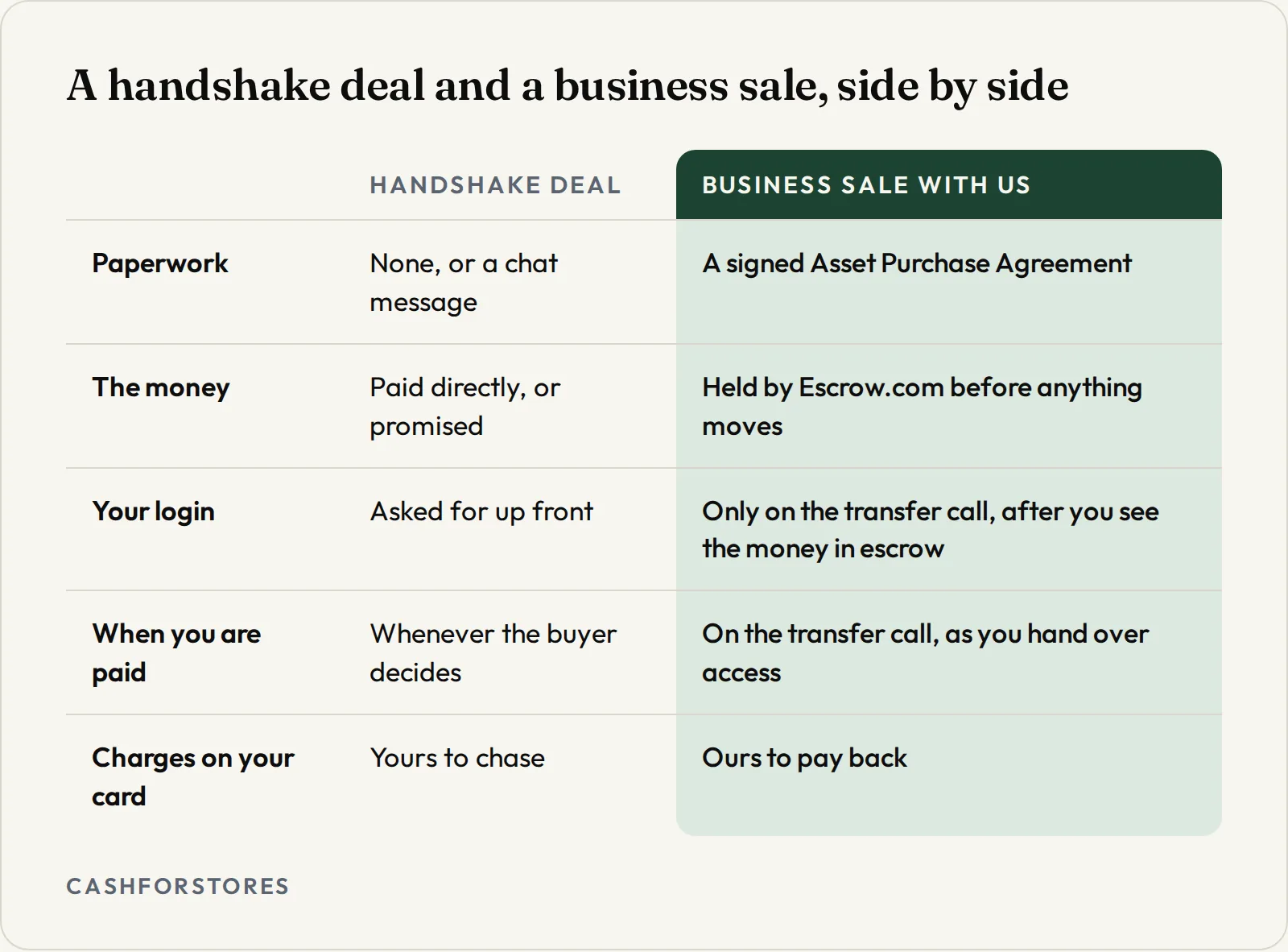
An Asset Purchase Agreement, or APA, is the signed contract that records the sale as a business asset sale. Ours is drawn up by lawyers who handle multi-million dollar acquisitions, and it sets out what happens, when payment lands, and what protections you have. It asks you to confirm you are the rightful owner of the account, with full authority to sell and transfer it. It arrives as a no-login link on our own agreements page, and it keeps your personal and business documents confidential. If a buyer will not put the deal in writing, that is the entire answer about the buyer.
Funds held by a licensed third party
Escrow is a neutral third party that holds the buyer's money until the transfer is done. We pay through Escrow.com, a licensed escrow agent holding California Department of Financial Protection and Innovation escrow licence 9631867. That licence is checkable on Escrow.com's licences page, and you should check it.
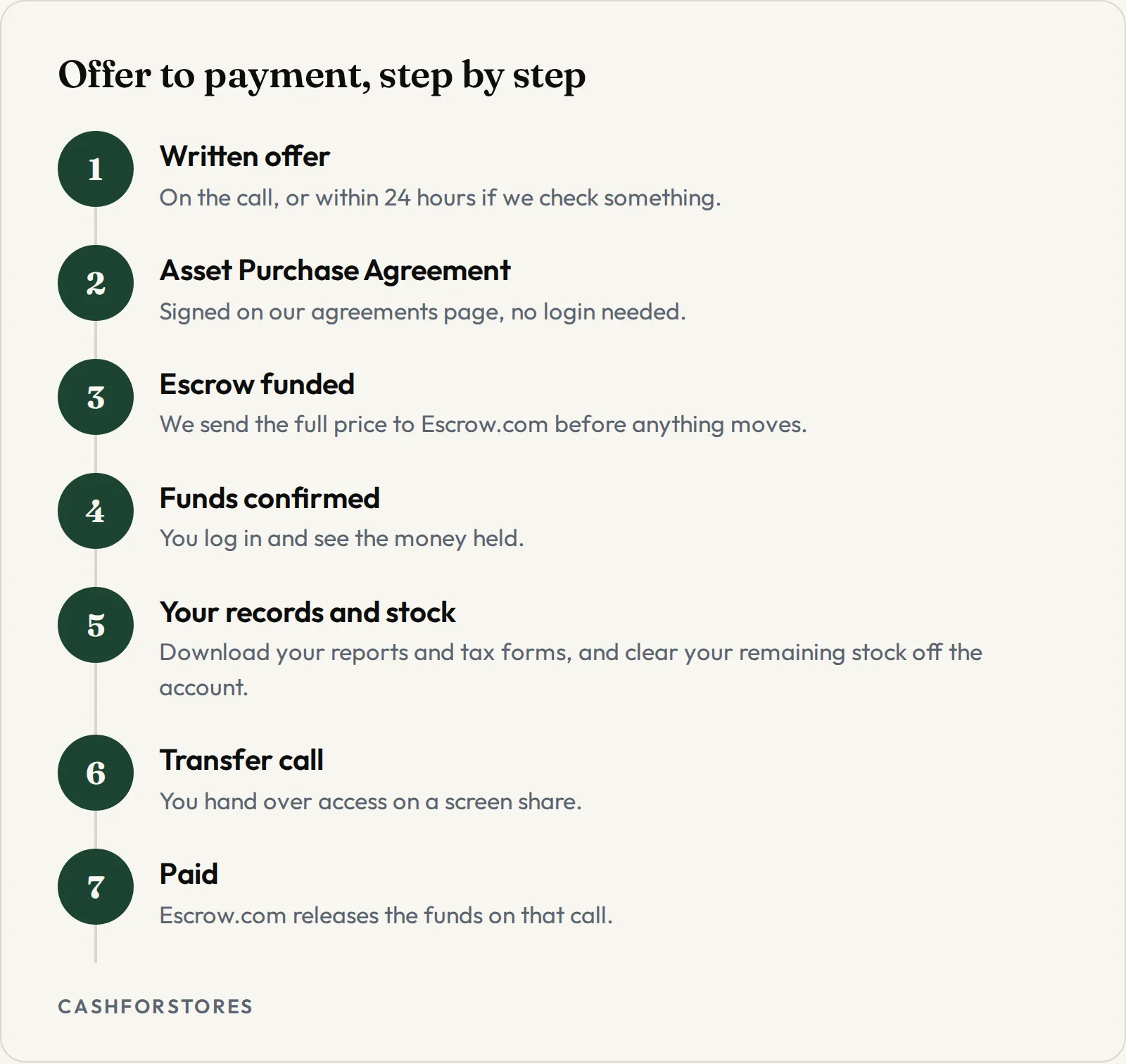
We send the full price to Escrow.com ourselves, before anything moves. You can log in and see the money sitting there before you hand anything over. Escrow.com releases it to you on the transfer call, the moment you hand over access. More on how escrow protects you.
Disclosure rather than concealment
A legitimate deal is one where both sides know what is changing hands:
- Account health tells a buyer what the account can do from day one.
- Suspension history, even if resolved, is part of the account's history, and that history decides what the account is worth.
- Whether other accounts exist matters because of the code of conduct rule above.
Hiding any of it does not protect you. It puts the whole deal at risk.
Red flags in a buyer
The same list applies to anyone who offers to buy your account, including us. Walk away if a buyer:
- Wants to pay you directly rather than through a licensed escrow agent
- Will not sign a written agreement
- Asks for your login before an agreement is signed
- Asks for access before you can see the funds held
- Offers a strong price without looking at the account first
- Promises the transfer will be invisible to Amazon
- Cannot tell you who the buying entity is
Any one of those is a reason to stop. Our buying entity is Seller Solutions Global LLC, trading as Cash For Stores.
From the evaluation call to payment
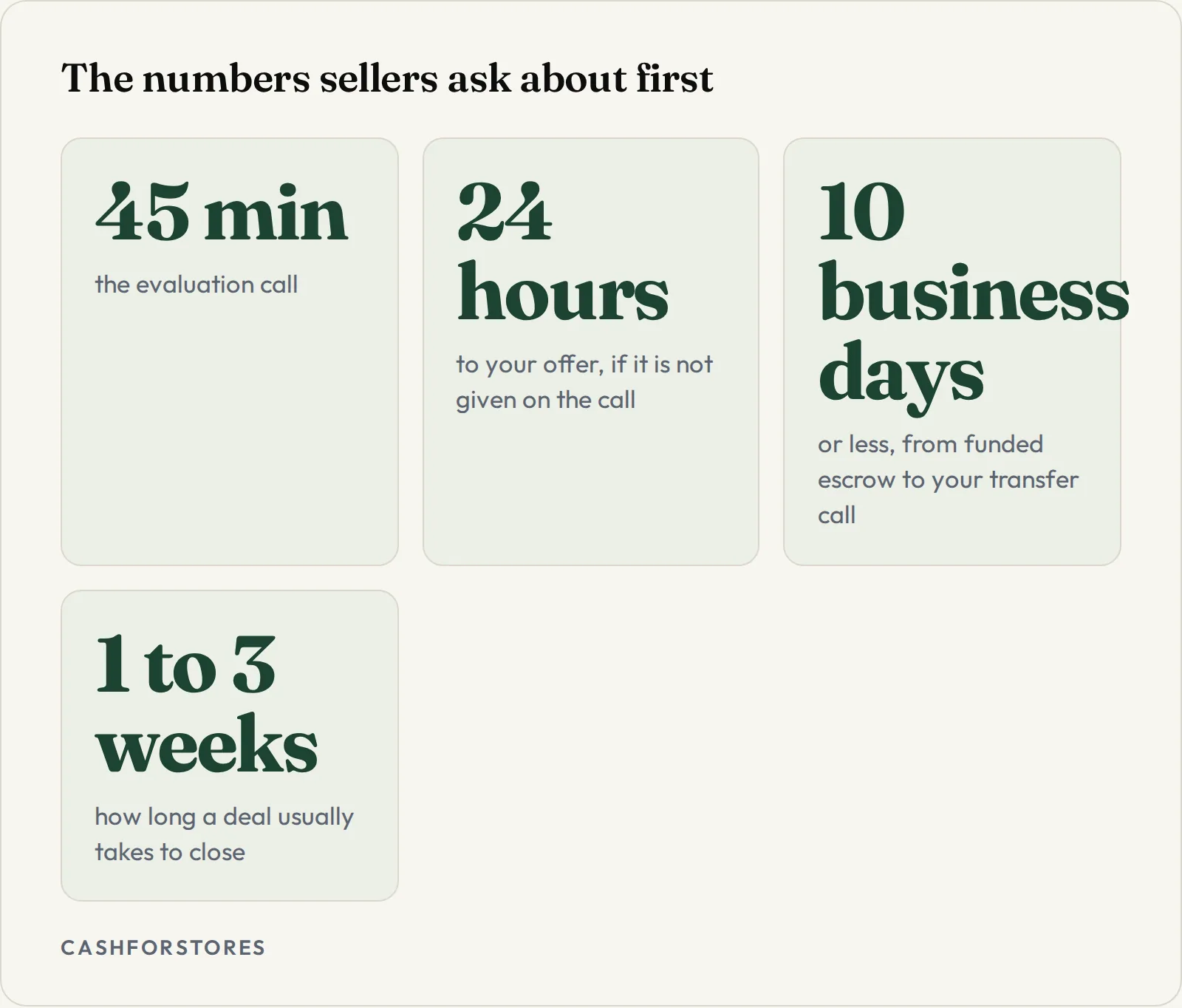
Everything below starts once you have had the evaluation call, a free 45-minute screen share where we open the account together. Most sellers get a number on the call itself, and if we need to check something internally, within 24 hours.
The transfer call is booked within 10 business days of escrow being funded, and a deal usually closes in one to three weeks. The money then reaches your bank in about 1 business day by US wire, 3 to 5 business days by international wire, or about 3 business days by the free electronic transfer. We cover the Escrow fee either way.
About half of transfers draw a later check by Amazon of the new owner, which takes 30 to 60 days. That is the buyer's wait, not yours. You were already paid on the transfer call. Stay reachable afterwards, and forward us any marketplace emails or codes that reach you.
What you give up
The transfer call is the one part of the deal that cannot be undone. You hand over access to the account, and there is no walking it back afterwards.
Anything you want to keep, sales reports, tax forms, a copy of past 1099s, should come off the account before that call. We can usually request a 1099 for you afterwards, but it is easier to grab your own records first. Your inventory is yours: we buy only the account, so you clear the remaining stock off it before the transfer.
Your card, bank details and tax ID stay on the account until it reaches its new owner. We cannot give you a date for that, because it depends on when we pass the account to its next owner and how long the marketplace takes. In the meantime, any charge that lands on your card is ours, and on the day your details come off, we tell you in writing.
Can a suspended account still be sold?
Sometimes. A suspension for fraud, counterfeit or a related-account ban takes an account off the table. Outside those three, a suspension that can be fixed is a postponement, not a rejection: we buy accounts in good standing, so you come back to us once Amazon lifts it. We do not offer reinstatement as a service.
Tell us about any suspension on the first call, and we will tell you plainly which case applies. Which suspended accounts can still be sold covers this in detail.
Where this leaves you
We have bought 1,600+ accounts this way.
Book a free evaluation and we will open the account with you for about 45 minutes. There is no obligation to take the offer. If you are not ready yet, the offer stands and you can come back when you are.
If you want to buy an aged account rather than sell one, that is a different business: Seller Accounts handles that side.
This article is general information about how account sales are structured. It is not legal advice. If a specific transaction matters to you, have a lawyer review it.
FAQ
Is selling an Amazon seller account a crime?
We do not give legal advice. How a sale closes is in the short answer at the top of this page, and if a specific deal matters to you, have a lawyer look at it.
What if Amazon finds out the account was sold?
The sale is not hidden. It is recorded as a business asset sale on the signed agreement, your details are replaced by the new owner's, and the new owner tells Amazon the business was bought when the account goes through Amazon's own verification. We make no promise about what Amazon decides, and we will tell you plainly if anything in your account's history raises the risk.
Am I obligated to accept your offer?
No. An offer from us is an offer, not a commitment, and nobody is forced to sell. If it is the price, tell us, and if the account is worth it we may come back with a revised offer. The sale only becomes firm when the Asset Purchase Agreement is signed.
What happens to charges on my card after the sale?
We pay them back by gift card, Zelle or bank transfer, whichever you prefer. That repayment sits outside escrow.
Related pages
Ready to Find Out What Your Account Is Worth?
Get a free evaluation and a concrete cash offer. No obligations, no pressure. Every deal is protected by Escrow.com.
Get My Cash Offer