How Escrow Protects You When Selling Your Amazon Account

Rated 4.9 on Trustpilot. Free offer within 24 hours, paid through Escrow.com.
The Short Answer
Escrow protects you when selling your Amazon account by putting the buyer's full payment with a licensed third party before you hand over any access. The money is released to you on the transfer call, the moment access changes hands.
Selling an Amazon seller account has one dangerous moment: the point where you hand over access before the money is confirmed. Escrow closes that gap. If you want to sell your Amazon seller account, this is the part of the deal that keeps you safe, and it is the part a bad buyer will try to skip.
We have bought 1,600+ Amazon seller accounts since 2020.
What is escrow, and who holds the money?
Escrow is a licensed third party holding the buyer's money while a transfer happens, then releasing it once both sides have done their part. On our deals that third party is Escrow.com, a licensed escrow agent holding California licence 9631867 with the Department of Financial Protection and Innovation. The money sits with the agent, not with the buyer.
You can check that licence yourself on Escrow.com's licences page, and you should. Escrow.com describes its own role in one line: "Escrow.com holds funds while goods move and services are completed."
On a Cash For Stores deal, we are the buyer. Our own money leaves us and sits with Escrow.com before you hand over anything, not the other way around. We send it by bank transfer ourselves, so you are never the one working out how the money should move.
The written agreement is the Asset Purchase Agreement (APA). It is the signed contract that sets out what is being sold, the price, and your confirmation that you are the rightful owner of the account, with full authority to sell and transfer it. Escrow does not replace that agreement.
Thinking of selling? Two-minute form, a 45-minute call, your offer within 24 hours.
How does the money move on a sale?
The money moves in one direction only, and you can see it before you act. You sign the APA, we fund Escrow.com by bank transfer, you log in and see the money held "In Escrow", then you hand over access on a screen-share call and Escrow.com releases the funds to you on that call.
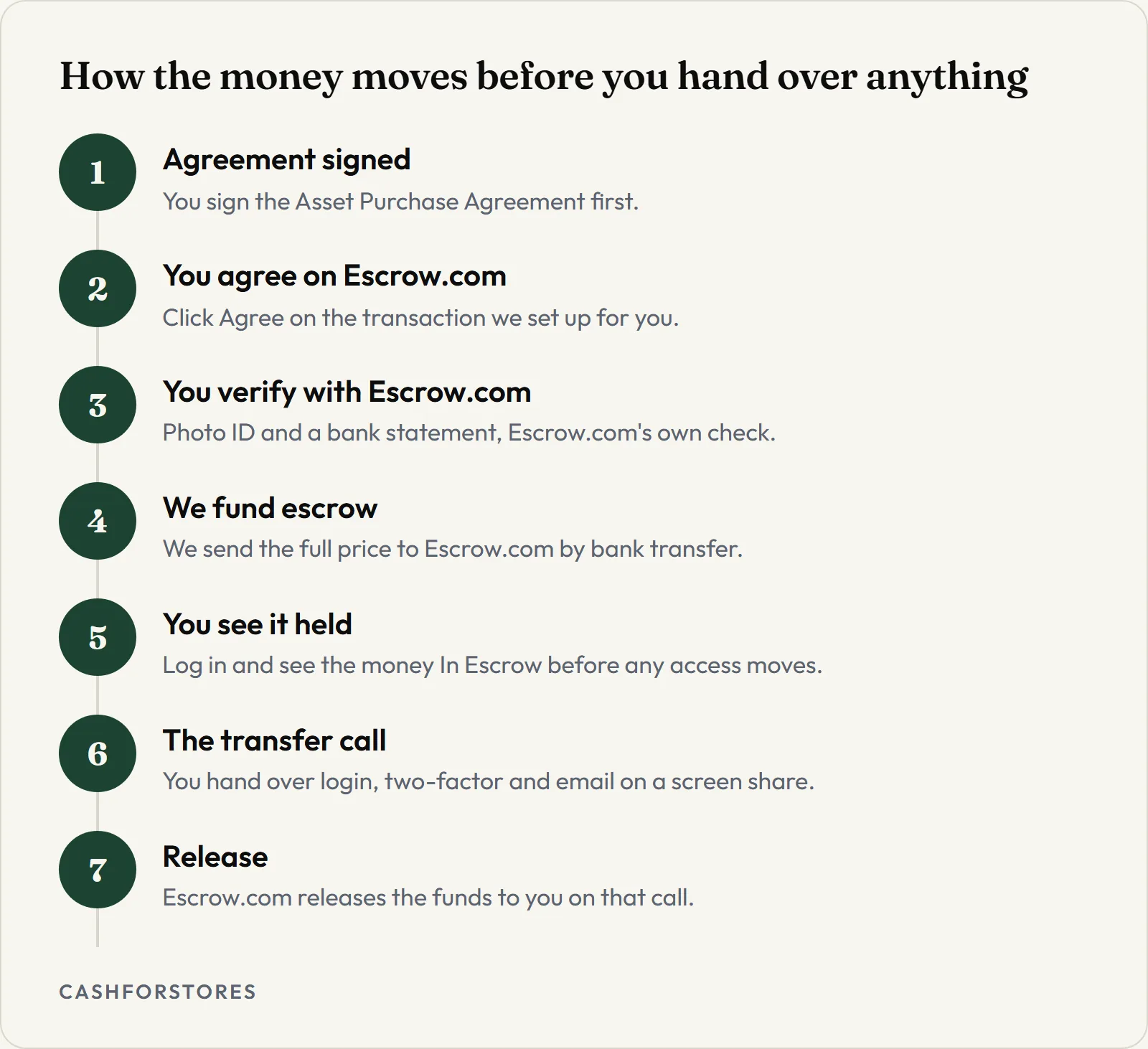
After you click Agree, Escrow.com may ask you to verify your own Escrow.com account with a photo ID and a bank statement, plus the formation document if the account is registered to a company. That is Escrow.com's own check, not ours. It usually takes about a day, so expect it as a normal step. If Escrow asks for a copy of the agreement you signed, we send it.
The step that matters most is the fifth one. You do not begin the transfer on a promise that money exists. You begin it after the escrow agent shows it is holding the money.
Escrow.com's own page puts it this way: "The Seller is notified to ship the merchandise and services once Escrow.com confirms funds have been approved and secured from the Buyer and all anti-fraud regulations have been met."
The transfer call is booked within 10 business days of the escrow being funded, and a deal usually closes in one to three weeks from start to finish. The whole route, from the two-minute form to the 45-minute evaluation call and the offer, is in how to sell your Amazon seller account for cash.
What does escrow protect you from?
Escrow protects a seller from four common ways a private account sale goes wrong: handing over access and never being paid, a buyer vanishing halfway, a payment reversed after the handover, and a deal that rests on one person's word. Each risk exists because the money and the account move at different times.
- Non-payment after transfer. The money is already deposited before you hand anything over.
- A buyer disappearing mid-process. Funds are already committed.
- A reversed payment. Escrow.com's protection page speaks to this directly: "As the Seller, you're also protected from any unexpected chargebacks, thereby ensuring that you won't fall prey to a scam."
- One person's word against another's. A signed Asset Purchase Agreement puts what you are owed in writing.
Escrow.com also screens the people on both sides. In its words: "Escrow.com also vets Buyers and Sellers to ensure fraudulent users are removed."
Why is a direct payment a red flag?
A buyer who refuses escrow is asking you to carry all of the risk. A buyer who will not use escrow has told you enough. The purchase price of every Cash For Stores deal pays out through Escrow.com. No informal transfers, no crypto, no personal wires for the purchase price.
| Question | Paid through escrow | Paid directly by the buyer |
|---|---|---|
| Where the money sits during the transfer | With Escrow.com, a licensed escrow agent | With the buyer |
| When you hand over access | After you see the money held | On trust |
| What happens on a chargeback | Escrow.com says sellers are protected | You carry it |
What does escrow not do?
Escrow secures the money; it does not check the account, and it does not replace the paperwork. A proper deal has three separate protections: the Asset Purchase Agreement, a live look at the account before any number is agreed, and escrow. Skip one and part of the deal runs on trust.
| Protection | What it covers | What it does not cover |
|---|---|---|
| The Asset Purchase Agreement | What is being sold, the price, and who owns it | Whether the money is real |
| Live inspection before an offer | For the buyer: whether the account is what the seller says it is | Where the money sits, or whether it gets paid |
| Escrow | That the money exists and is released on the agreed terms | What is being sold |
That live inspection is the evaluation call: 45 minutes on a screen share, opening the account together before any number is agreed. What to expect on the evaluation call walks through it.
What does escrow cost, and how fast do you get paid?
On our deals, escrow costs you nothing. No upfront fee, no escrow fee, no transfer fee: we cover Escrow.com's fees, and the number on the offer is the number that reaches you. Escrow.com releases the money on the transfer call, and you choose how it is sent to your bank.
The one choice that is yours is the payout method:
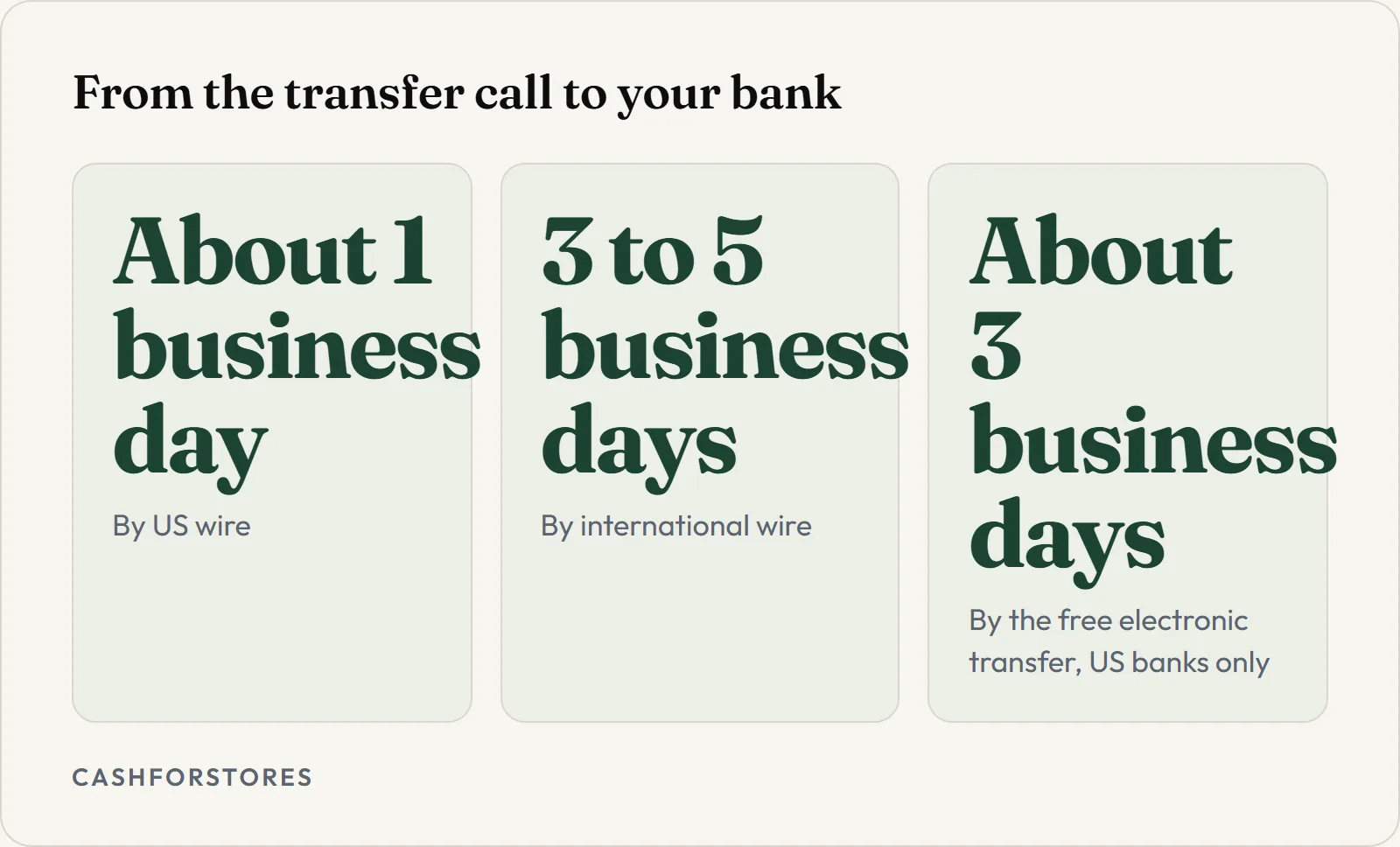
The free electronic transfer is for US bank accounts only.
What an account is worth depends on its history, and the offer comes on the call. How much your Amazon seller account is worth covers what sets the number.
Can I sell my Amazon seller account safely?
Yes, when the account is in good standing, registered to you as its original owner, and the sale runs through a signed Asset Purchase Agreement and a licensed escrow agent. Escrow makes the payment safe. Whether your account can be sold at all depends on its history, which is what the evaluation call checks.
A suspension that is not for fraud, counterfeit or a related-account ban can be fixed, and the account can be sold once it is reinstated. We do not offer reinstatement. If you are still deciding whether a sale is possible, start with can I sell my Amazon seller account?.
An offer from us is an offer, not a commitment. Nobody is forced to sell. The sale becomes firm when the Asset Purchase Agreement is signed, and you are paid on the transfer call.
The Rule Worth Remembering
Never hand over access before the funds are confirmed held. Not for a trusted-looking buyer, not for a partial payment, not because someone is in a hurry.
If you are ready to find out what your account is worth, book the evaluation call. If you want to buy an aged account rather than sell one, that is a different business: Seller Accounts.
FAQ
Do I wait for Amazon's check before I am paid?
No. Amazon's later check of the new owner happens after the transfer call and is the buyer's wait, not yours. The money has already been released to you before that check starts.
What happens to my card and bank details after the sale?
Your card, bank details and tax ID stay on the account until it reaches its new owner, and we cannot name a date for that. Any charge that lands on your card in the meantime is ours, paid back by gift card, Zelle or bank transfer, outside escrow.
What if the buyer disappears after I hand over access?
In a properly run deal, access only changes hands after Escrow.com is holding the full price, and the money is released to you on that same call. Watch for a buyer who wants access first and the money second.
Is an email asking for my account details part of the escrow process?
A real Escrow.com request comes on the transaction we set up for you, and it can ask for a photo ID and a bank statement. If anything else asks for your details, check with us before you act.
Related pages
Ready to Find Out What Your Account Is Worth?
Get a free evaluation and a concrete cash offer. No obligations, no pressure. Every deal is protected by Escrow.com.
Get My Cash Offer