Why Won't a Broker List My Amazon Business? Who Buys It Instead

Rated 4.9 on Trustpilot. A free cash offer, usually on the call itself, paid through Escrow.com.

The Short Answer
It is usually arithmetic, not a verdict on your small Amazon business: a broker is paid a commission on the sale, and a small sale does not pay for the work a listing takes. We buy the seller account itself, directly, and there is no fixed minimum on its age or lifetime sales.
So the broker's no closes one door. It does not make the account worthless.
Why does a broker turn down a small Amazon business?
A broker turns down a small business because the commission on a small sale does not cover the work. Listing a business means valuing it, writing it up, screening buyers and walking them through their checks. Those checks are called due diligence: the buyer's look through the books, the products and the account before they pay.
On a small business, the buyer still wants that look, and the broker still has to run it.
There is a second reason, and it hits sellers who are leaving. A broker sells profit. A buyer of a business pays for what it will earn next year, so the broker needs a record of earnings to show. When you have already slowed down, stopped restocking or let the ads lapse, there is little left for a broker to sell, even when the account underneath is in good shape.
Thinking of selling? Two-minute form, a 45-minute call, your offer usually on the call itself.
Is there a minimum revenue to sell an Amazon FBA business?
There is no single minimum revenue to sell an Amazon FBA business. The only reliable figure is the one a firm gives you in writing. When you sell us the seller account, there is no fixed minimum on age or lifetime sales.
If a broker turned you down, ask them one plain question: what is the smallest sale you take on, and is it measured on revenue or profit?
An aggregator is a company that buys many Amazon brands and runs them together. A dormant store with a good account and no current profit is still something we buy.
What a Broker Sells and What We Buy
The difference is the asset. A broker sells a business on its earnings. We buy the Amazon seller account on its own history.
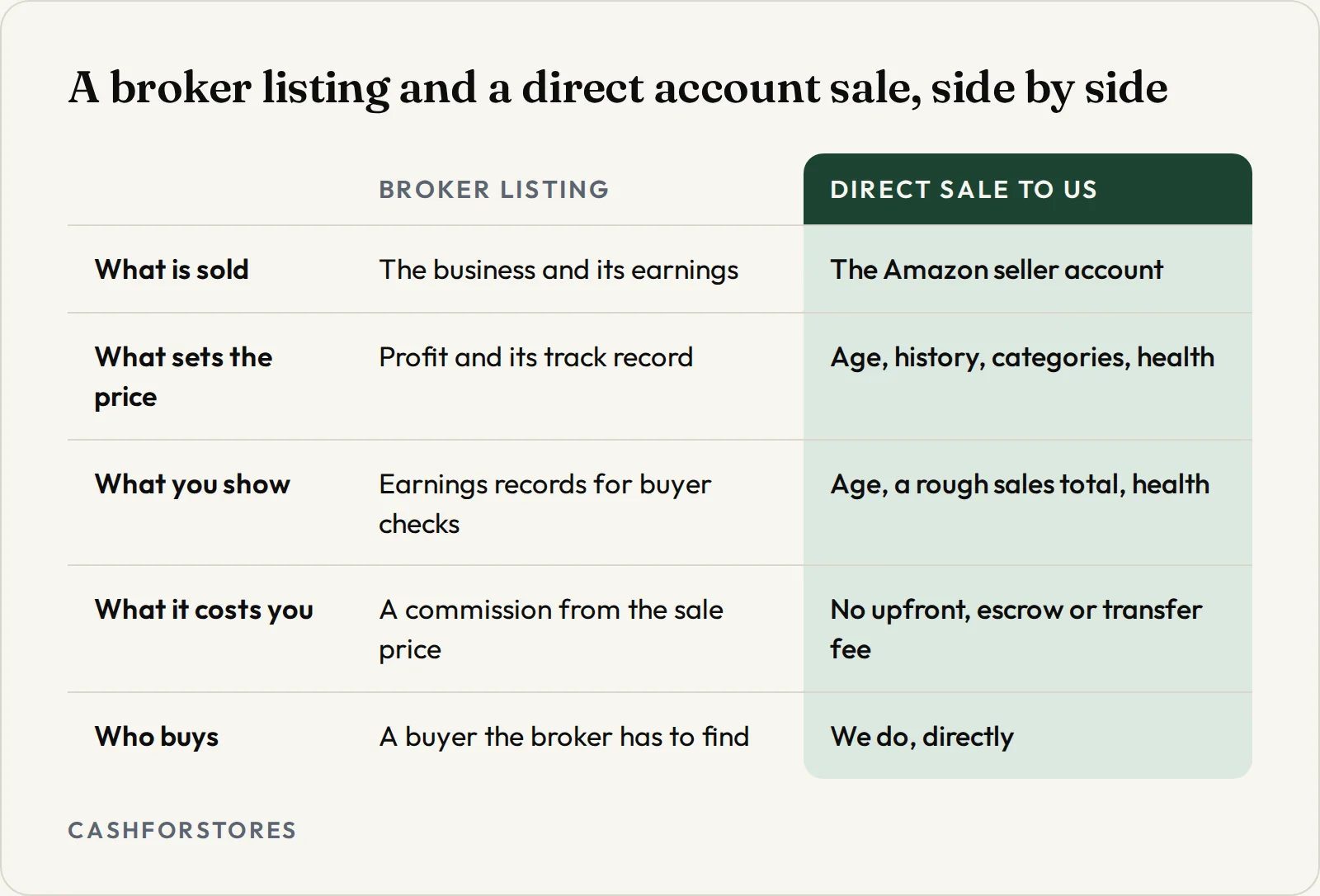
Three more differences:
| Broker listing | Direct sale to Cash For Stores | |
|---|---|---|
| Login or bank details before a contract | Ask the broker | Never: we do not need a login, a password, bank details or tax documents to value an account |
| Your inventory | Can be part of the business | Stays yours; clear it before the transfer, under about 100 units left is fine |
| When you are paid | When the business sale closes | On the transfer call, through Escrow.com |
A seller in your position does not need to pick the "right" route on paper. If you have profit worth selling, a broker can be the better fit. If the profit is small, falling or gone, the account is usually what still has value, and that is what we buy.
What makes a small account worth buying?
A small account is worth buying for what it already carries: its age, its sales history, the categories it is approved in, its account health and any Brand Registry. Little or no recent activity is fine, because the age is the asset. Even an account that never took an order is still worth a look; it is simply worth less.
Every offer we make rests on three things: what the account is worth on the market, how long it takes us to resell it, and the risk we carry during the transfer. The offer is not a judgement of your business.
What we need to value it is short:
- how old the account is
- a rough total of its sales over its life (a ballpark is fine)
- its health: any suspensions, warnings or open issues
- which categories and brands it can sell in
If you have another selling account, that is not an automatic no. What matters is that the accounts were kept apart, with different information in each. A linked second account is a reason we decline.
A suspension changes the picture, but it does not always end it. A suspended account can still be sold when the suspension is not for fraud, counterfeit or a related-account ban. With us, a suspension that can be fixed means the sale waits until the account is reinstated. We do not offer reinstatement as a service.
How does a direct sale work?
A direct sale starts with a two-minute form and a 45-minute evaluation call on a screen share. The offer comes on the call or within 24 hours. If you accept, you sign our Asset Purchase Agreement, we fund Escrow.com, and you hand over access on a transfer call, where Escrow.com releases your money to you.
An Asset Purchase Agreement is the written contract that records the sale as a business asset sale. Escrow means a neutral third party holds the price until the handover is done. Ours is Escrow.com, licensed by the California Department of Financial Protection and Innovation, licence 9631867.
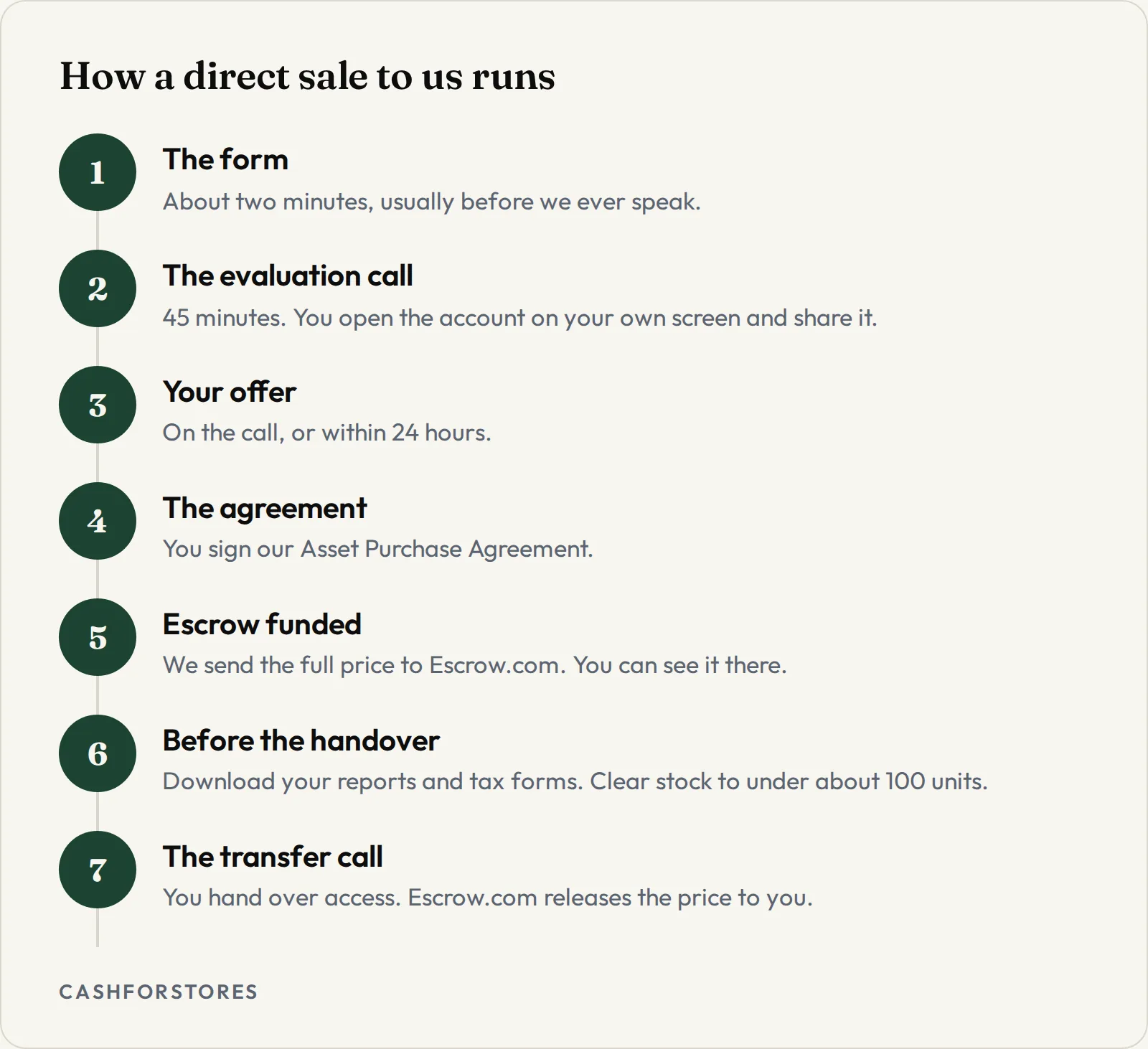
A few details sellers ask about:
- Timing. The transfer call is booked within 10 business days of the escrow being funded. A deal usually closes in one to three weeks.
- The payout. About 1 business day by US wire, 3 to 5 business days by international wire, or about 3 business days by the free electronic transfer. We cover the Escrow fee either way.
- Amazon's side. Amazon's later check of the new owner is the buyer's wait, not yours. You are paid on the transfer call.
Amazon's how to sell page carries one number worth knowing: more than 60% of sales in the Amazon store come from independent sellers, most of them small and medium-sized businesses. Plenty of those businesses will never be big enough for a broker. Their accounts still carry age and history. We have bought 1,600+ seller accounts since 2020.
If you want to know what yours is worth before you decide anything, send us the form. The offer is an offer, not a commitment.
FAQ
Why did a broker reject my online business?
Only the broker can tell you their reason, so ask them. Whatever it was, it was about their listing, not about the account underneath. Before you close that account, have it valued: its age is the asset, and there is no upfront fee to find out.
Do aggregators buy small Amazon FBA brands?
We cannot speak for any aggregator's criteria; ask them directly. If your brand is too small for them, the seller account can still be sold on its own. That is the part we buy.
Can I sell an account that has had no sales for a while?
Yes. Bring the date of your last sale, even if it was years ago, with the account's age and a rough sales total. Our guide to selling an inactive account covers what we look at.
Does a direct sale take a cut the way a broker's commission does?
No. There is no upfront fee, no escrow fee and no transfer fee. We take no cut, and we cover the Escrow fee.
Related pages
Ready to Find Out What Your Account Is Worth?
Get a free evaluation and a concrete cash offer. No obligations, no pressure. Every deal is protected by Escrow.com.
Get My Cash Offer