Amazon Account Health Dropping: Should You Fix It or Sell?

Rated 4.9 on Trustpilot. Free offer within 24 hours, paid through Escrow.com.

The Short Answer
If you plan to keep selling, you should fix what is dragging the score first; if you already know you are leaving, sell while the account is still active and in good standing, because a deactivated account cannot be sold to us until it is reinstated.
The choice is still yours while the account is live.
What does a dropping account health rating actually mean?
A dropping rating means your account is moving toward Amazon's deactivation bands: under 200 it turns yellow, At Risk, and at 99 or lower it is red, eligible for deactivation. Your Account Health Rating (AHR) is Amazon's score of how close your selling account is to deactivation for breaking certain selling policies.
It runs from 0 to 1,000. Green, 200 and up, means not at risk. Yellow, 100 to 199, means at risk. Red, 99 or lower, means eligible for deactivation or already deactivated.
The AHR sits on your Account Health page in Seller Central, one score for each store you sell in.
200 to 1,000
Green, Healthy: not at risk of deactivation
100 to 199
Yellow, At Risk: at risk of deactivation
99 or lower
Red, Unhealthy: eligible for deactivation or already deactivated
The score looks back over your last 180 days of policy adherence and selling activity.
How the points move, in Amazon's words: "Upon detection of any new policy violations associated with your selling account, you lose points. You gain points when you successfully address those violations."
Amazon also says all new sellers start at 200, and that points are granted when a minimum number of orders are filled, so the score reflects the size of your business. The full bands and rules are on Amazon's Account Health Rating program policy page.
Thinking of selling? Two-minute form, a 45-minute call, your offer within 24 hours.
Why is my account health rating dropping?
There are two causes, and they need different responses. Either Amazon recorded a new policy violation, which costs points, or orders you fulfilled have moved out of the 180-day window the score covers, which can lower it with no new problem at all. Your Account Health page shows which violations are counting against you.
Amazon says the score can move both ways as time passes: you may see it rise as old violations leave the window, and "your AHR score may decrease as orders fulfilled move out of the 180-day period". That second line is the one sellers miss. A store that has slowed down can watch its score slide without breaking a single rule.
| A new violation | Orders ageing out | |
|---|---|---|
| What you see | A violation counting against you on the Account Health page | A lower score, no new violation counting against you |
| What causes it | A breach of a policy included in the AHR | Fewer recent fulfilled orders inside the 180 days |
| What helps | Addressing the violation | More recent fulfilled orders inside the 180 days |
| What it says about the account | A compliance problem to deal with | A quieter store, with no violation behind the drop |
Amazon's AHR pages give no point values for a single violation or order. The list of policies that count is on Amazon's Account health rating page; check there rather than guessing.
Fix it or sell it: how do the two compare?
Fixing keeps the account and its income, but takes your time and only works if you can address what Amazon flagged. Selling hands the account over and pays you once, on the transfer call, but only while the account is active with no suspension, deactivation or unresolved appeal. The choice turns on whether you are staying.
| Fix it | Sell it | |
|---|---|---|
| Your time | Ongoing: addressing each violation and keeping orders filled inside the 180 days | One form, one 45-minute call, one transfer call |
| What you keep | The account and its future income | Cash; you clear and keep your stock |
| When it pays off | Only if sales and the score recover | On the transfer call, through Escrow.com |
| Best when | You plan to keep selling | You already know you are leaving |
| What decides success | Whether Amazon accepts that each violation was addressed | Whether the account is active and in good standing when we look at it |
| Risk while you wait | Repeat violations can put the account at immediate risk | A suspension in the meantime puts the sale on hold |
| Your details on the account | Stay, with every future email and violation yours to answer | You stay reachable for marketplace emails and codes |
| Money | Future sales, if they come | A cash offer, on the call or within 24 hours |
When does fixing make more sense?
Fix it when you plan to keep selling and the drop comes from orders ageing out of the window or from violations you can address. Amazon gives points back when a violation is successfully addressed, and old violations stop counting once they pass the 180-day window.
How to fix each cause. For orders ageing out, the fix is filling orders again: Amazon grants points when a minimum number of orders are filled. For a violation, open each one on your Account Health page, address it in a timely manner, and stay reachable.
Act early. Amazon's own warning for an account in yellow: "If you don't address these violations and we are unable to reach you to help proactively address these violations, the account will most likely be deactivated."
Watch repeat violations closely. Amazon's policy: "The maximum number of repeat violations for a given policy may vary depending on the severity of the violation, but can be as low as two violations for higher severity violations." Reach that maximum for one policy inside 180 days and the account may be at immediate risk of deactivation.
When does selling make more sense?
Sell when you already know you are leaving and the account is still active. An active account with no suspension, deactivation or unresolved appeal is one we can value now. That includes an appeal still open on a violation, so close it out before the call. Wait until it is deactivated and the sale goes on hold.
Selling fits better in situations like these:
- You stopped sourcing months ago. The score is sliding because orders are ageing out. Fixing it means restarting a business you meant to close.
- Fees eat most of what you make. You could fix the violations, but you would be fixing a business you do not want to run.
- A partner left and the account landed on you. You want cash and a clean end.
Can I still sell my account if it is At Risk?
It can be, while it is active. At Risk is a warning band, not a suspension. We buy accounts in good standing, with no suspension, deactivation or unresolved appeal, and we check a yellow account against that on the 45-minute evaluation call.
Its health is one of the things that set the offer, along with age, sales history, approved categories and Brand Registry.
Brand Registry is Amazon's program for trademark owners to register and protect their brand. Approved categories are the ones Amazon has cleared the account to sell in.
What sets the number in more detail is in how much is my Amazon seller account worth.
How does a sale run once you decide?
A sale to us usually closes in one to three weeks. You send a two-minute form, we look at the account together on a 45-minute screen-share call, and the offer comes on the call or within 24 hours. You sign an Asset Purchase Agreement, we fund Escrow.com, and you are paid on the transfer call.
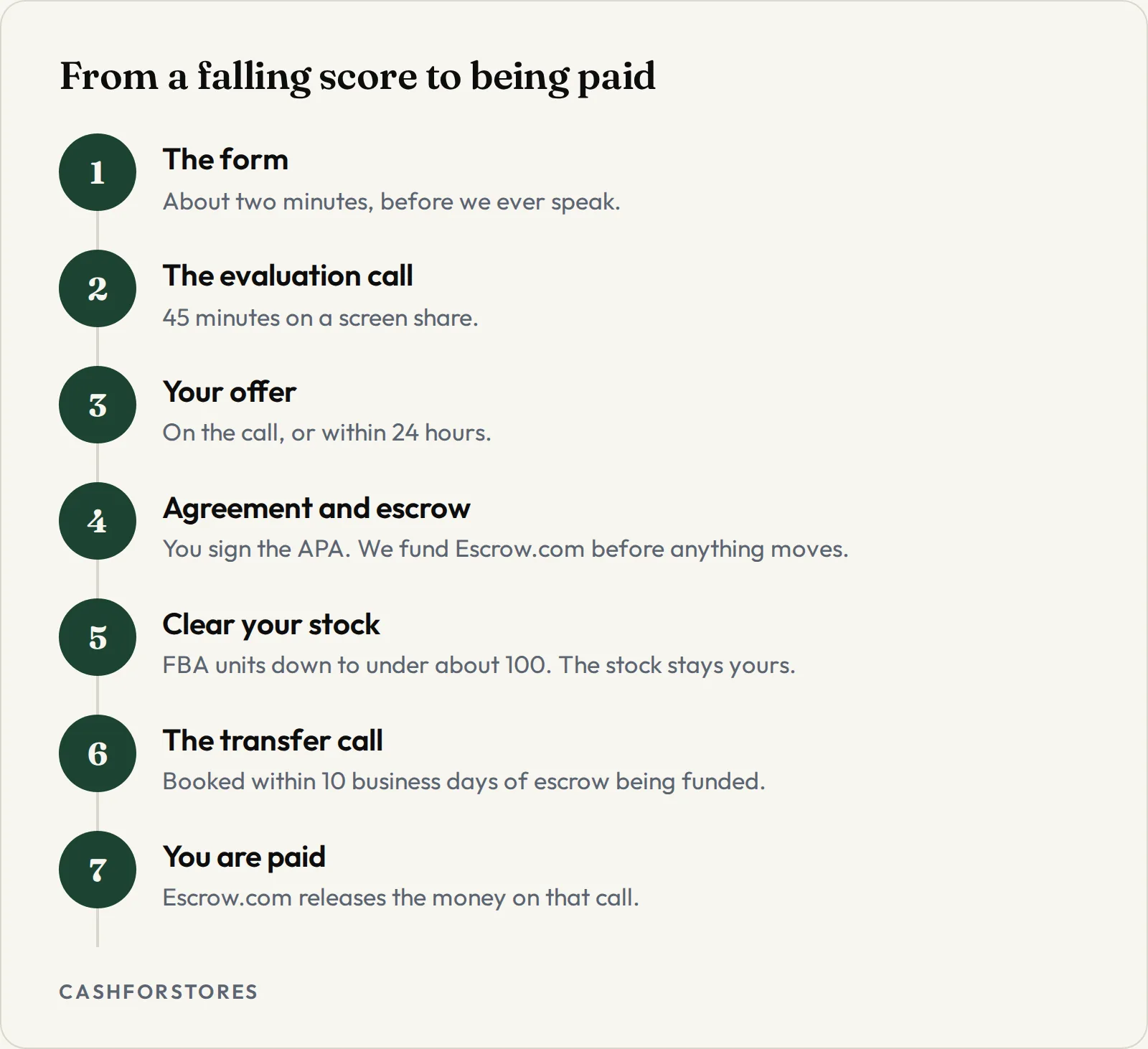
The Asset Purchase Agreement (APA) is the written contract that records the sale. Escrow.com is a licensed escrow agent (California DFPI licence 9631867) that holds the purchase price until you hand over access. We fund it ourselves, and you can see the money there before anything changes hands.
Before the transfer, clear your FBA stock (Fulfillment by Amazon, the units stored in Amazon's warehouses) down to under about 100 units, since we buy the account and not the inventory.
From the transfer call, the money reaches your bank in about 1 business day by US wire, 3 to 5 business days by international wire, or about 3 business days by the free electronic transfer. We cover the Escrow fee either way.
Amazon may check the new owner after the handover, on about half of transfers, and that can take 30 to 60 days. That wait belongs to the new owner, not to you. You are already paid.
We have bought 1,600+ seller accounts from their original owners since 2020. If you have decided, send us the form. If you are still unsure a sale is possible at all, start with can I sell my Amazon seller account.
FAQ
Is a score of 200 or more safe?
Amazon says a green score, 200 to 1,000, means the account is not at risk of deactivation based on the policies in the score. Keep reading the Account Health page even in green.
Will a low rating lower my offer?
It can. An account's health is one of the things that set the offer, along with its age, sales history, approved categories and Brand Registry. The number itself comes on the call, once we have seen the account.
Can you help me fix my account health or appeal a deactivation?
No. Reinstatement, appeals and complaint removal are not services we offer. You address violations yourself from the Account Health page, and if the account is reinstated, you are welcome to come back to us.
My account is already deactivated. Can I still sell it?
Not to us while it is deactivated. A suspension that can be fixed puts the sale on hold until it is reinstated; one for fraud, counterfeit or a related account ends it. Read can you sell a suspended Amazon seller account before you decide anything.
I want to buy an account, not sell one. Where do I go?
Our sister brand Seller Accounts sells aged accounts to buyers, at selleraccounts.com. Cash For Stores only buys.
Related pages
How Much Is My Amazon Seller Account Worth? What Sets the Price
Can You Sell a Suspended Amazon Seller Account?
Ready to Find Out What Your Account Is Worth?
Get a free evaluation and a concrete cash offer. No obligations, no pressure. Every deal is protected by Escrow.com.
Get My Cash Offer